Learn to understand your birth chart. Decode planets, houses & signs in your Kundli. Beginner astrology guide!
Your birth chart, known as a Kundli in Vedic astrology, is like a snapshot of the sky at the exact moment you were born. It maps the position of planets, houses, and zodiac signs, and helps you understand patterns in personality, relationships, career direction, and timing.
Why Kundli Matters
The kundli is often called a “blueprint of destiny,” but a better way to think about it is a map. A map doesn’t force you to take one road—it simply shows the landscape so you can make smarter choices. Your chart highlights natural strengths, repeating challenges, and the kind of environments where you grow faster.
That’s why people in India still look at a kundli before big decisions such as marriage, career changes, business partnerships, naming ceremonies, and property purchases. A good reading doesn’t create fear—it gives clarity: what to prioritize, what to be patient about, and which remedies (upay) can reduce stress during difficult phases.
Before You Start (What You Need)
To read your kundli in a way that actually makes sense, make sure your birth details are accurate. Even small errors can shift the Ascendant (Lagna) or house placements.
- Date of birth: Day, month, year.
- Exact time of birth: Prefer hospital record. (A difference of 10–20 minutes can matter.)
- Place of birth: City and country (time zone and latitude/longitude affect calculations).
If you are unsure about the birth time, an astrologer may use birth time rectification (matching life events with planetary periods) to get closer to the correct Lagna.
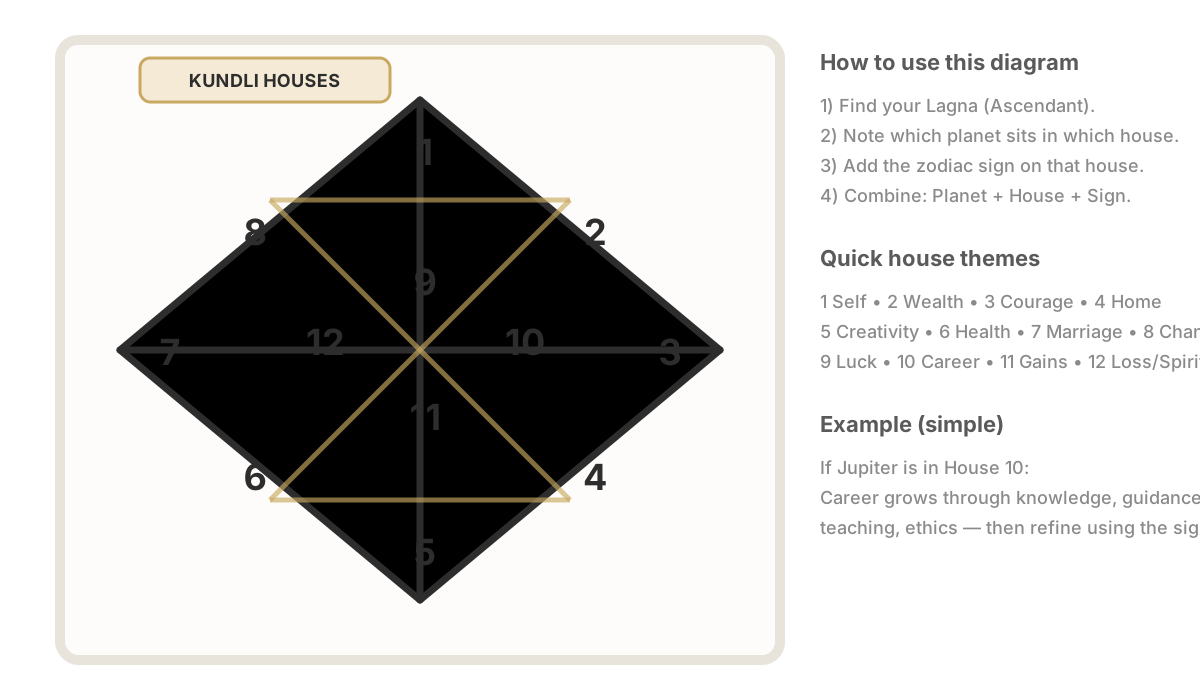
Kundli Diagram: Houses 1–12
Most kundli charts are shown as a set of compartments called houses (Bhavas). Think of houses as “life departments.” Planets are the “actors,” signs are the “mood/style,” and houses are the “stage.”
Main Elements of a Birth Chart
A full kundli contains many layers (divisional charts, nakshatras, dashas, yogas), but beginners get the best results by mastering the core building blocks first.
- Lagna (Ascendant): Represents personality and outlook on life.
- Moon sign (Rashi): Emotions, comfort zone, and how you process life internally.
- Sun sign: Vitality, confidence, identity, and the desire to “shine.”
- Planets: Each planet represents specific themes like career, love, learning, discipline, or transformation.
- Houses: Twelve houses show where life events and responsibilities play out—wealth, marriage, education, home, status, and more.
- Aspects (Drishti) & combinations (Yogas): How planets influence each other and create helpful or challenging results.
Once you understand these, you can gradually add advanced layers like Nakshatra (lunar mansion) and Dasha (planetary periods) for timing.
Planets (Navagraha) in Simple Words
In Vedic astrology we work with nine “grahas” (Sun, Moon, Mars, Mercury, Jupiter, Venus, Saturn, Rahu, Ketu). A simple way to remember them is: each planet is a function in your life.
- Sun: Confidence, authority, leadership, father-figures, purpose.
- Moon: Mind, emotions, mother-figures, comfort, habits.
- Mars: Energy, courage, action, competition, siblings.
- Mercury: Thinking, communication, business, skills, learning.
- Jupiter: Wisdom, teachers, growth, children, dharma.
- Venus: Love, relationships, beauty, pleasure, arts, luxury.
- Saturn: Discipline, responsibility, delays, long-term success, karma.
- Rahu: Desire, obsession, ambition, unusual paths, foreign influence.
- Ketu: Detachment, spirituality, past-life mastery, minimalism.
Important: planets don’t make you “good” or “bad.” They describe how energy flows. Even Saturn (often feared) can give strong results when you work patiently and consistently.
Houses (Bhavas): Life Areas
The twelve houses show the areas of life where you experience growth and events. Beginners often memorize house meanings like a list; a better approach is to learn the story of each house.
- 1st house: Self, body, identity, overall direction (your “starting point”).
- 2nd house: Money saved, family values, speech, food habits.
- 3rd house: Courage, effort, communication, younger siblings, short travel.
- 4th house: Home, mother, property, comfort, education foundation.
- 5th house: Creativity, intelligence, romance, children, learning.
- 6th house: Health, routines, service, enemies, debts, daily work.
- 7th house: Marriage, partnerships, business alliances, public dealing.
- 8th house: Sudden change, secrets, research, inheritance, transformation.
- 9th house: Luck, faith, higher learning, mentors, long journeys.
- 10th house: Career, status, responsibility, recognition, public work.
- 11th house: Gains, networks, friends, fulfillment of desires.
- 12th house: Expenses, sleep, foreign lands, isolation, spirituality, liberation.
When a planet sits in a house, it tries to “do its job” in that life area. When a house is empty, it doesn’t mean you won’t have results—it usually means the story depends more on the house lord and aspects.
Signs (Rashis): The “Style” of Expression
Signs are like the tone or “language” through which a planet behaves. Mars behaves differently in Aries than in Cancer. Jupiter expresses differently in Sagittarius than in Capricorn. So if planets are the “what,” signs are the “how.”
Here’s an easy way to remember the sign elements:
- Fire (Aries, Leo, Sagittarius): action, confidence, speed.
- Earth (Taurus, Virgo, Capricorn): practicality, structure, results.
- Air (Gemini, Libra, Aquarius): ideas, communication, social connection.
- Water (Cancer, Scorpio, Pisces): emotion, intuition, depth.
So when you read a placement, ask: is it fiery and direct, earthy and steady, airy and intellectual, or watery and emotional?
How to Read Your Chart Step-by-Step
If you are a beginner, don’t try to interpret 50 things at once. Use this simple order and you’ll get meaningful insights quickly.
- Start with Lagna: Note your Ascendant sign and the 1st house condition. This sets your overall life approach.
- Check the “Big Three”: Lagna, Moon, and Sun. Together they describe how you act (Lagna), feel (Moon), and build identity (Sun).
- Look at the 10th and 7th houses: These are two most visible areas—career (10th) and relationships/partnerships (7th).
- Read one placement properly: Choose one planet and read it as planet + house + sign. Example: “Mercury in the 2nd in Virgo” will sound very different than “Mercury in the 2nd in Aries.”
- Notice aspects (drishti): If a strong planet aspects your 10th house, career becomes a major life theme even if the 10th looks “empty.”
- Use timing (Dasha) later: First learn “what” your chart says, then learn “when” it activates.
Try writing three sentences only:
- My chart shows I naturally… (Lagna + 1st house)
- I feel most stable when… (Moon sign + Moon house)
- I grow in career by… (10th house + its lord)
House Lords & Aspects (Drishti)
Two concepts make kundli reading much easier (and prevent wrong conclusions): house lords and aspects.
- House lord: Every sign has a ruling planet. When a sign sits on a house, that ruling planet becomes the lord of that house. The house lord tells you how that life area works and where its results “flow.” For example, if the 10th house sign is ruled by Saturn, then Saturn’s placement and strength strongly shape career outcomes.
- Aspects (Drishti): Planets influence (cast a glance on) other houses/planets. So even if a house looks empty, it can still be very active because a powerful planet aspects it.
A simple beginner rule: when you read any topic (career, marriage, health), check the relevant house, its lord, and any strong aspects. This gives a balanced picture quickly.
Nakshatra & Dasha (Timing) — Beginner Intro
After you understand the basics, two advanced layers add depth and timing:
- Nakshatra: A finer division of the zodiac (27 lunar mansions). It explains how a planet behaves at a deeper level—motivation, style, and subtle traits. Two people can have “Moon in Cancer,” yet feel very different because the Moon sits in different nakshatras.
- Dasha: A system of planetary periods that shows when certain themes become louder. You may have a strong “career potential,” but it usually rises most during the right dasha/antardasha.
If you ever felt, “My chart says X, but it’s not happening,” the answer is often timing. That’s where dasha analysis becomes extremely practical.
Common Beginner Mistakes
- Judging a single placement: No planet is “good” or “bad” alone. Results change with sign strength, aspects, and house lordship.
- Ignoring the house lord: The planet ruling a house (lord) often explains outcomes better than just planets sitting there.
- Over-focusing on “dosha”: Doshas are real concepts, but balance matters—many charts have cancellations or supportive yogas.
- Using astrology to delay action: Kundli is meant to guide your effort, not replace it.
How Kundli Guides You
When you study your chart properly, you can choose better strategies and timings instead of guessing. Astrologers typically help in three practical ways:
- Clarity: understanding strengths (what comes naturally) and weaknesses (what needs structure).
- Timing: choosing supportive windows (muhurta) for important events and understanding why some periods feel slower.
- Remedies (Upay): simple, safe remedies like mantra, charity, or lifestyle changes to reduce pressure in tough phases.
A good kundli reading should leave you with a short list of actions: what to do more of, what to avoid, and what to be patient about.
Tip: Keep an open mind—astrology is a guide, not a fixed rulebook. The kundli is meant to empower, not limit you.
Get Professional Kundli Reading
If you're looking for an expert astrologer in Ahmedabad, our team specializes in comprehensive Kundli analysis. We also offer numerology consultations and Vastu guidance for a complete life assessment.
Free Astrology Tools
- Find Your Rashi (Zodiac Sign) - Calculate your moon sign instantly
- Find Your Nakshatra (Birth Star) - Discover your birth constellation
- Today's Rashifal - Daily horoscope for all zodiac signs
- Panchang Today - Daily Hindu calendar with tithi & nakshatra