How to Read Panchang
Master the ancient art of reading Panchang (पंचांग). Learn about Tithi, Nakshatra, Yoga, Karana & Vaar to find the most auspicious timings for weddings, ceremonies, and important life events.
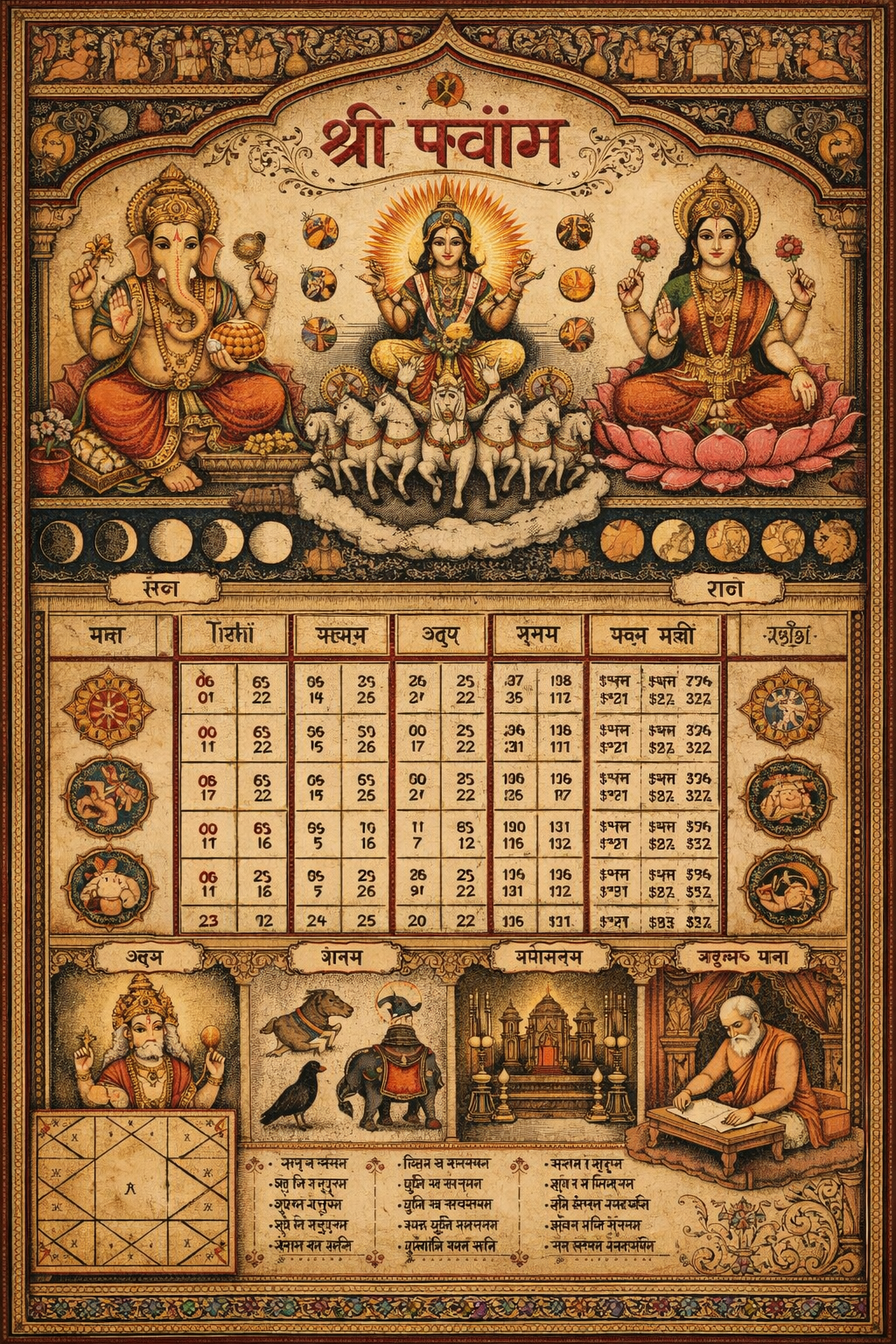
Table of Contents
What is Panchang?
Panchang (पंचांग), also spelled as Panchangam, is the traditional Hindu calendar and almanac that has been used for thousands of years to determine auspicious timings, religious festivals, and daily activities. The word "Panchang" comes from Sanskrit: "Pancha" meaning five and "Anga" meaning limbs or parts.
Unlike the Western Gregorian calendar that is purely solar-based, Panchang is a lunisolar calendar that tracks both the Moon's phases and the Sun's position. This makes it incredibly precise for astrological calculations and determining the most favorable moments for important life events like marriages, housewarming ceremonies, business ventures, and religious rituals.
💡 Quick Tip: Panchang is not just a calendar—it's a comprehensive guide that tells you the quality and energy of each moment, helping you align your actions with cosmic rhythms for better outcomes.
The Five Elements of Panchang (Panchānga)
Every Panchang consists of five essential components that together reveal the complete astrological picture of any moment. Understanding each element is crucial for reading and interpreting the Panchang correctly:
| Element | Sanskrit | Meaning | Count |
|---|---|---|---|
| Tithi | तिथि | Lunar Day | 30 (15 per paksha) |
| Nakshatra | नक्षत्र | Star Constellation | 27 |
| Yoga | योग | Luni-Solar Combination | 27 |
| Karana | करण | Half of Tithi | 11 (4 fixed + 7 rotating) |
| Vaar | वार | Weekday | 7 |
Let's explore each element in detail to understand how they work together to determine auspiciousness.
Understanding Tithi (Lunar Day)
Tithi is the lunar day and is considered the most important element of the Panchang. It represents the angular relationship between the Sun and Moon. A tithi completes when the Moon moves 12 degrees away from the Sun.
Two Phases (Paksha)
🌙 Shukla Paksha (Bright Half)
From New Moon to Full Moon. The Moon waxes (grows brighter). Tithis 1-15, ending with Purnima.
🌑 Krishna Paksha (Dark Half)
From Full Moon to New Moon. The Moon wanes (grows darker). Tithis 1-15, ending with Amavasya.
The 15 Tithis and Their Names
Important Tithis to Know
- Ekadashi (11th): Highly auspicious for fasting, spiritual practices, and worship
- Purnima (Full Moon): Excellent for ceremonies, celebrations, and starting new ventures
- Amavasya (New Moon): Best for ancestor worship (Pitru Tarpan), Tantra practices
- Chaturthi (4th): Generally avoided for travel and new beginnings
- Ashtami (8th), Navami (9th), Chaturdashi (14th): Called "Rikta Tithis" - often avoided
📖 How to Read: In a Panchang, look for "Tithi" field. It will show the Tithi name (e.g., "Chaturdashi") along with the Paksha (Shukla/Krishna) and the exact timing when it starts and ends.
Nakshatra (Star Constellation)
Nakshatra refers to the lunar mansion or star constellation where the Moon is positioned at any given time. There are 27 Nakshatras, each spanning 13°20' of the zodiac. Nakshatras play a crucial role in Muhurat selection and compatibility matching (Kundli Milan).
The 27 Nakshatras
Nakshatra Categories for Muhurat
✅ Auspicious (Shubh) Nakshatras
Rohini, Mrigashira, Pushya, Uttara Phalguni, Hasta, Swati, Anuradha, Shravana, Dhanishta, Shatabhisha, Uttara Bhadrapada, Revati
⚠️ Avoid for Major Events
Ashlesha, Magha, Jyeshtha, Mula (known as Gandmool Nakshatras - need special remedies)
📖 How to Read: Panchang shows the current Nakshatra name and the exact time it ends. For example: "Nakshatra: Rohini till 14:32" means Rohini Nakshatra is active until 2:32 PM.
Yoga (Luni-Solar Day)
Yoga is calculated from the combined angular relationship between the Sun and Moon. There are 27 Yogas, each covering 13°20' of the combined movement. Yoga indicates the overall energy and auspiciousness of the day.
The 27 Yogas with Nature
💡 Key Insight: Yogas like Siddhi, Shubha, Amrit, Shiva are highly auspicious. Avoid Vyatipata, Vaidhriti, Vishkumbha for important ceremonies.
Karana (Half of Tithi)
Karana is half of a Tithi. Since each Tithi has 2 Karanas, there are 60 Karanas in a lunar month. However, only 11 Karanas exist – 4 fixed and 7 rotating.
🔄 Seven Rotating Karanas (Chara)
These repeat 8 times in a month:
- Bava - Good for all activities
- Balava - Auspicious
- Kaulava - Good for relationships
- Taitila - Good for business
- Gara - Good for agriculture
- Vanija - Good for trade
- Vishti (Bhadra) - Inauspicious
📌 Four Fixed Karanas (Sthira)
Occur once per month:
- Shakuni - Second half of Krishna Chaturdashi
- Chatushpada - First half of Amavasya
- Naga - Second half of Amavasya
- Kimstughna - First half of Shukla Pratipada
⚠️ Avoid Vishti/Bhadra Karana: This is considered highly inauspicious for starting new ventures, marriages, travel, or any important activity. Always check if Bhadra Karana is active before planning events.
Vaar (Weekday)
Vaar refers to the seven days of the week, each ruled by a specific planet (Graha). The ruling planet influences the energy and activities best suited for that day.
| Day | Sanskrit | Ruling Planet | Best For |
|---|---|---|---|
| Sunday | Ravivaar (रविवार) | Sun (Surya) | Government work, leadership, health |
| Monday | Somvaar (सोमवार) | Moon (Chandra) | Travel, creativity, new beginnings |
| Tuesday | Mangalvaar (मंगलवार) | Mars (Mangal) | Property, machines, courage-based tasks |
| Wednesday | Budhvaar (बुधवार) | Mercury (Budh) | Education, business, communication |
| Thursday | Guruvaar (गुरुवार) | Jupiter (Guru) | Marriage, education, religious activities |
| Friday | Shukravaar (शुक्रवार) | Venus (Shukra) | Marriage, arts, luxury, relationships |
| Saturday | Shanivaar (शनिवार) | Saturn (Shani) | Iron/oil work, remedies, charity |
📖 Quick Reference: Thursday (Guruvaar) and Friday (Shukravaar) are generally considered most auspicious for weddings and major ceremonies. Tuesday and Saturday are often avoided for new beginnings.
Practical Example: Reading Today's Panchang
Let's see how to read an actual Panchang entry step by step:
Sample Panchang Reading
✅ Interpretation:
- • Morning (till 14:20) has Shubha Yoga - excellent for important work
- • Avoid starting new activities between 07:15-18:45 due to Vishti Karana
- • Uttara Bhadrapada is auspicious - good for ceremonies
- • After 18:45, Bava Karana begins - suitable for new beginnings
Check Today's Panchang
View complete Panchang details for today with all five elements:
View Today's PanchangFrequently Asked Questions About Panchang
Need Expert Muhurat Selection?
Get personalized Muhurat selection for your important events from our expert astrologer. We consider all Panchang elements to find the perfect timing for you.
Book Consultation